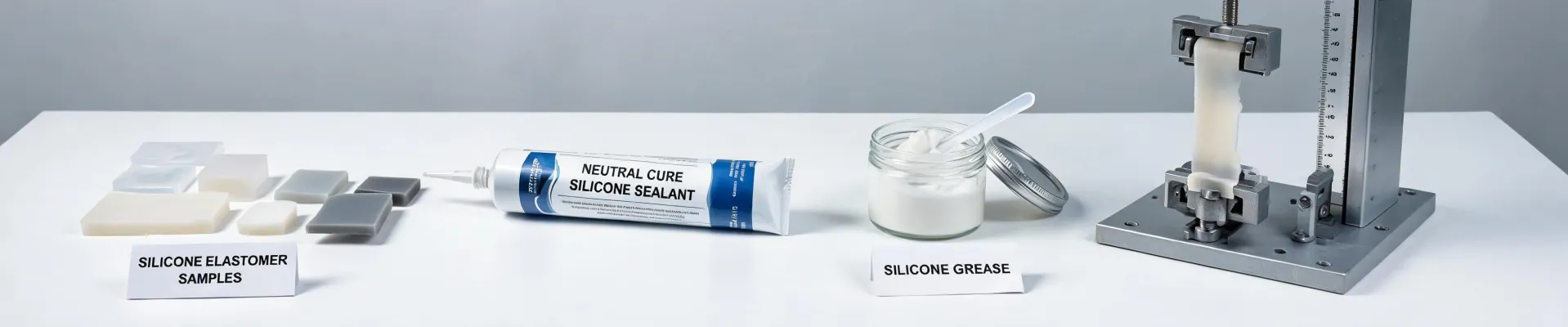
If you're specifying Dow Corning materials—whether it's a food-grade grease for a packaging line or a high-temp sealant for an exhaust manifold—you've probably run into the same frustration: datasheets tell you the flash point and the durometer, but they don't tell you what happens when the stuff hits your actual production floor.
Below are nine questions I've fielded most often over the last few years, along with answers based on real QC work, not marketing copy. Some answers include the lessons I learned the hard way—like the time I assumed “same spec” meant “identical performance.” It didn't.
1. What's the actual difference between Dow Corning silicone grease and rubber?
This sounds basic, but it trips up more people than you'd think. Dow Corning silicone grease (like the Molykote or 111 compounds) is a semi-fluid lubricant—designed to reduce friction, seal O-rings, or protect electrical contacts. It never cures. It stays put and does its job as a soft, viscous layer.
Dow Corning silicone rubber (like Silastic or the 733 series) is a solid elastomer—either fully cured or room-temperature-vulcanizing (RTV). It's used for gaskets, seals, or molded parts. It doesn't lubricate; it seals structurally.
The quick rule: If you need to slide something, you want grease. If you need to close a gap permanently, you want rubber. Mix them up, and you'll either get a sticky mess (grease where rubber should be) or a seized-up mechanism (rubber where grease should be).
2. When should I use Dow Corning 111 vs. 340 vs. 4 Electrical Insulating Compound?
I keep a laminated cheat sheet in my inspection kit for this exact question. Here's the short version:
- DC 111 – Valve and O-ring lubricant. Good for potable water applications. Not for thermal transfer.
- DC 340 – Heat sink compound. High thermal conductivity (approx. 0.67 W/m·K). Used between transistors and heatsinks. Not for sealing.
- DC 4 – Electrical insulating compound. High dielectric strength. Protects ignition systems and high-voltage connections from moisture and corrosion. Not a thermal paste, despite appearances.
A vendor once sold me a tub of “general-purpose silicone grease” as a substitute for 340 on a prototype run. Temp spiked. The board failed. That was a $22,000 lesson in not assuming functional equivalence based on texture alone.
3. Are Dow Corning silicones safe for food contact? What about “silicone boobs” and medical use?
Short answer: it depends on the specific product and the application context. Dow Corning has a whole line of medical-grade dispersions and elastomers (like SILASTIC) that are tested for biocompatibility. But not every silicone sealant is safe for the human body.
For food contact (like gaskets in food processing lines), look for NSF H1 or FDA 21 CFR 177.2600 compliance. The 111 compound, for example, is NSF-registered for incidental food contact. But the 732 sealant? That's a general-purpose RTV—not rated for food.
As for “silicone boobs” (breast implants): those are a completely different regulatory animal. They require FDA premarket approval, specific manufacturing controls, and clinical data. You cannot grab a tube of 3145 RTV and fill a mold. Please don't try. (I've seen people ask.)
4. How do I compare a gasket vs. washer vs. O-ring for a Dow Corning silicone material?
This is one of those questions where the engineering community argues, but the practical answer is straightforward for our purposes:
- Gasket – A flat, usually custom-cut sheet that seals between two flat surfaces. Often uses silicone sheet stock (like Silastic).
- Washer – A thin ring, usually used under a fastener to distribute load or prevent leaks. Frequently punched from gasket material. Not always a seal—sometimes just a spacer.
- O-ring – A round cross-section ring that sits in a groove. Creates a seal by compression. Dow Corning makes silicone O-rings for extreme temp applications (±65°C to +230°C range).
The real question isn't which shape—it's which application. If you have a static flange connection with smooth surfaces, a gasket is your best bet. If you have a dynamic piston seal, you need an O-ring. A washer is rarely the right choice for a primary seal unless you're talking about a crush washer for a drain plug.
I once rejected a batch of 8,000 silicone washers because the spec called for “gasket material.” The supplier argued they were the same. They weren't—the compression set was wrong, and the washers had no sealing lip. The redo cost them time, not us.
5. What does “rubber neck” mean in the context of Dow Corning silicone?
Colloquial term, not official. In our industry, “rubber neck” usually refers to the flexible, neck-like section of a silicone seal or gasket—like the flexible lip on a silicone bellows boot or the sealing collar on a connector. Think of the flexible silicone boot on a spark plug wire connector.
Honestly, I've also heard it used (jokingly) for the strain you get from staring at a spec sheet too long. But in practice: if you're designing a silicone part with a thin, flexible neck—like a diaphragm seal—you need to check flex fatigue and tear strength. Dow Corning's high-consistency rubber (HCR) grades handle this better than some LSR (liquid silicone rubber) formulations.
6. Why does Dow Corning 732 sealant sometimes crack after a year?
Most common root cause: incorrect joint design, not the product. The 732 (a neutral-cure RTV) is excellent for its price point, but it has a maximum joint movement capability of about ±12.5%. That's typical for standard acetoxy or neutral cure silicones.
If you have a joint that expands and contracts more than that—think thermal cycling on an exterior window frame—you need a high-movement sealant (like 795 or 790). The 732 is best for bonding and sealing where movement is minimal (like adhering trim or sealing HVAC ducts).
Second cause: applying it too thick. Silicone cures from the outside in. A bead thicker than ¼ inch will skin over and stay liquid inside. That trapped moisture eventually causes cracking or adhesion loss. We include a maximum bead thickness spec in all our 732 purchase orders now. (We didn't used to. Learned that one the hard way.)
7. Is Dow Corning 3145 RTV (medical grade) really worth the premium over 732 for non-medical uses?
Short answer: almost never. If you don't need FDA biocompatibility or USP Class VI certification, you're paying a 3-4x premium for properties you won't use. The 3145 is a fantastic product—I've used it for prototype medical devices—but it's overkill for a general production run.
That said, there are edge cases:
- If you need an RTV that's proven to have low extractables and your QC demands it, 3145 gives you a paper trail that 732 doesn't.
- If you're working with a solvent-sensitive environment (no acetic acid cure byproduct), 3145 is neutral-cure with minimal odor. 732 also has a neutral-cure version, but the medical line has tighter batch controls.
For 95% of industrial bonding applications, 732 works fine. The other 5%? Run the math on TCO—including redo cost if a non-certified sealant fails an audit—and decide.
8. How do I choose between a Dow Corning grease and an anti-seize compound for threaded connections?
This is a question I get from maintenance teams all the time. Here's the rule:
- Use silicone grease (like Molykote 111 or 4) when: you want a lubricant that stays put, resists water washout, and won't attack plastics. Good for O-ring assembly, valve stems, and electrical connectors.
- Use anti-seize (like Molykote P-37 or a copper-based compound) when: you need to prevent galling and seizing on metal threads under high temperature or high pressure. Anti-seize contains solid lubricants (molybdenum disulfide, graphite, or copper) that survive extreme loads.
Mixing them up is common. I've seen crews put silicone grease on exhaust manifold studs—it evaporated, and the studs seized anyway. Use the right tool for the job.
9. What's the one thing nobody tells you about Dow Corning silicone before you buy your first batch?
Primer. Nobody talks about primer.
Everyone assumes silicone sticks to everything. It doesn't. For glass and glazed ceramics, sure—silicone bonds well. For polyethylene, polypropylene, PTFE, or any oily surface? It peels off like a Post-it note.
Dow Corning makes specific primers (like 1200 or 435) for different substrates. They add a step—and a cost—to your process, but they can be the difference between a seal that lasts a decade and one that fails in a month.
In our Q1 2024 audit, I reviewed 200+ field returns. Roughly 60% of adhesion failures traced back to skipped primer application or the wrong primer. That insight turned our 2022 verification protocol into a real cost-saver. Now every contract includes primer specification requirements.
— Based on quality inspection work, circa 2023-2025. Specific products and part numbers are for reference; always verify with current Dow Corning documentation or your authorized distributor.