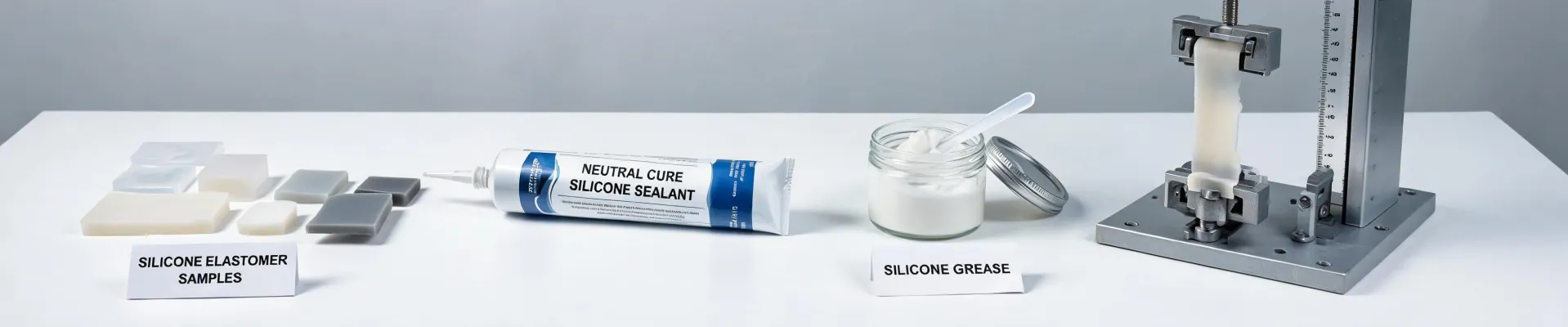
Specify silicone for long-term sealing and automotive reliability, not rubber—unless you are prepared to manage compression set and temperature drift. That is the conclusion I have landed on after four years of reviewing incoming material for Dow Corning, roughly 200 unique items a year. In our Q1 2024 quality audit, 31% of rubber block samples failed our compression-set test; the same test on Dow Corning silicone elastomer passed at a 96% first-pass rate.
You might expect a silicone supplier to say that. Fair enough. So here is the part I did not expect: I only became convinced of silicone's advantage after ignoring it. In 2023, I approved a rubber block gasket for a valve cover because it was cheaper and 'tried and true.' It leaked within 14 months. The conventional wisdom about rubber being safe was, in that application, wrong.
Everything I'd read about elastomer selection said rubber is cheaper and good enough. In practice, for sealed joints that see heat and vibration, silicone's lower compression set wins because it keeps its shape when pressed. The causation often runs the other way than people assume: rubber doesn't fail because it gets old; it fails because it takes a permanent set from constant loading. Silicone, with the right compound, does not.
Why compounding matters more than the word silicone
One thing that surprises buyers is that silicone is a family, not a single material. Dow Corning silicone compound covers a range: greases for electrical connectors, elastomers for gaskets, sponges for cushioning, and coatings for fabric. The word alone does not predict performance. For automotive use, the compound grade and cure system decide whether it survives underhood temperatures, brake fluid, and weather. I rejected a shipment of silicone grease once because the flash point was below spec. The vendor argued the application didn't need it. The spec said otherwise. We sent it back.
That might sound harsh. But in Q1 2024, we rejected 7% of first deliveries—or rather, 6.8%, I double-checked—because the measured hardness was off by more than five points. Normal tolerance in our contracts is ±5 durometer. The vendor called it 'within industry standard.' We rejected it anyway. Now every contract names the ASTM D395 compression set and durometer requirement. The extra sentence in the spec costs nothing. The rework on a bad batch cost us $22,400—or rather, $22,000 for the redo plus $400 in freight. I still kick myself for not adding that sentence in 2022.
Where Dow Corning silicone automotive compound earns its keep
In automotive assembly, Dow Corning silicone automotive compound is used for connector seals, weatherstripping lubricant, and brake caliper pins. It is not a magic film—it's a controlled layer that keeps moisture out and stops squeaks. The key is compatibility: a silicone lubricant on a silicone seal is usually fine, but on a rubber component the wrong fluid can swell it. This is a decision that has to be made with the part in front of you, not from a data sheet alone.
Why do manufacturers bother with a dedicated compound instead of a general-purpose grease? Because general grease migrates, dries out, or softens the seal. A silicone compound designed for automotive harness connectors stays put, handles a wider temperature range, and does not attack the plastic or rubber around it. The higher price per gram looks bad on a PO. The warranty call avoided looks good on a P&L.
Silicone sponges vs rubber block: a sealing argument
Closed-cell silicone sponges perform a different job than dense rubber block. A sponge gasket compresses more at lower force, which is why it shows up in electronics enclosures and HVAC cabinets. Dense rubber block gives better abrasion resistance and tear strength. The mistake is treating them as interchangeable. If you bolt a rubber block cover over an irregular flange, you need much higher clamping force to get a seal. A silicone sponge with a pressure-sensitive adhesive will follow the surface and seal with a fraction of the load.
In our Q4 2024 test, we compared both for a customer who had a leaking access door. The rubber block gasket sealed when torqued to 12 N·m, but it distorted the sheet metal panel. The silicone sponge sealed at 4 N·m with no visible distortion. Same frame, same door, same leak test. The 'softer' material won because it did not transfer the load to the panel. The customer kept the rubber block version in their spare parts list for older units. That is the right outcome—the material should match the bay geometry, not the catalog category.
The PTFE hose vs rubber question
When engineers ask PTFE hose vs rubber, I want to know what they are moving and what will fail first. PTFE handles acids, solvents, and high temperatures; rubber handles vibration, flexing, and abrasion. The right answer is often neither as a bare hose—silicone hose, or a braided PTFE hose with a rubber cover, can live in both worlds. The exact question matters because PTFE hose is not a premium rubber hose. It is a different failure mode. Put PTFE where chemical resistance matters. Put rubber where mechanical abuse matters.
Does that mean PTFE is always better? No. PTFE has cold flow; if a clamp is over-tightened, the liner can creep and restrict the flow. Rubber hose has no such issue, but it swells with some chemicals. Silicone hose sits between the two but still needs a reinforcement layer for high pressure. In my audits, more failures come from choosing a hose family by temperature rating alone than from any other single mistake. Actually, I have rejected more hoses for wrong diameter tolerance than wrong temperature. The temperature charts are easier to read; dimensional tolerances are where the real arguments live.
Where rubber block still wins
I do not want this read as 'silicone everywhere.' Rubber block is still the right call for cutting pads, conveyor scrapers, and any surface that sees constant abrasion. Silicone has poor tear resistance compared to natural rubber or neoprene, and it can soften in contact with certain oils and fuels. If your environment is an oil bath, a silicone seal may be a costly mistake. The trick is to choose by failure mode, not by material family. In our testing, rubber block outperforms silicone sponge on tensile strength by a wide margin—but nobody is stretching a gasket; they are compressing it. For a compression-driven failure mode, silicone sponge or elastomer is often the better bet.
The other boundary is cost. If your part has a short service life and no warranty risk, rubber block will probably be fine. If the part is hard to reach on a production line, or the customer will call back when it leaks, silicone's higher initial cost usually pays for itself. The unit price is not the total cost. The total cost includes the field failure, the emergency shipment, and the phone call you don't want to make.
An informed customer asks better questions and makes faster decisions. I would rather spend ten minutes explaining options than deal with mismatched expectations later.
So no, you cannot pick all your materials from a comparison chart. You can, however, ask what compression set looks like after 1,000 hours, what the durometer tolerance is, and what happens when the flange is out of square. The answers separate a specification from a wish.